

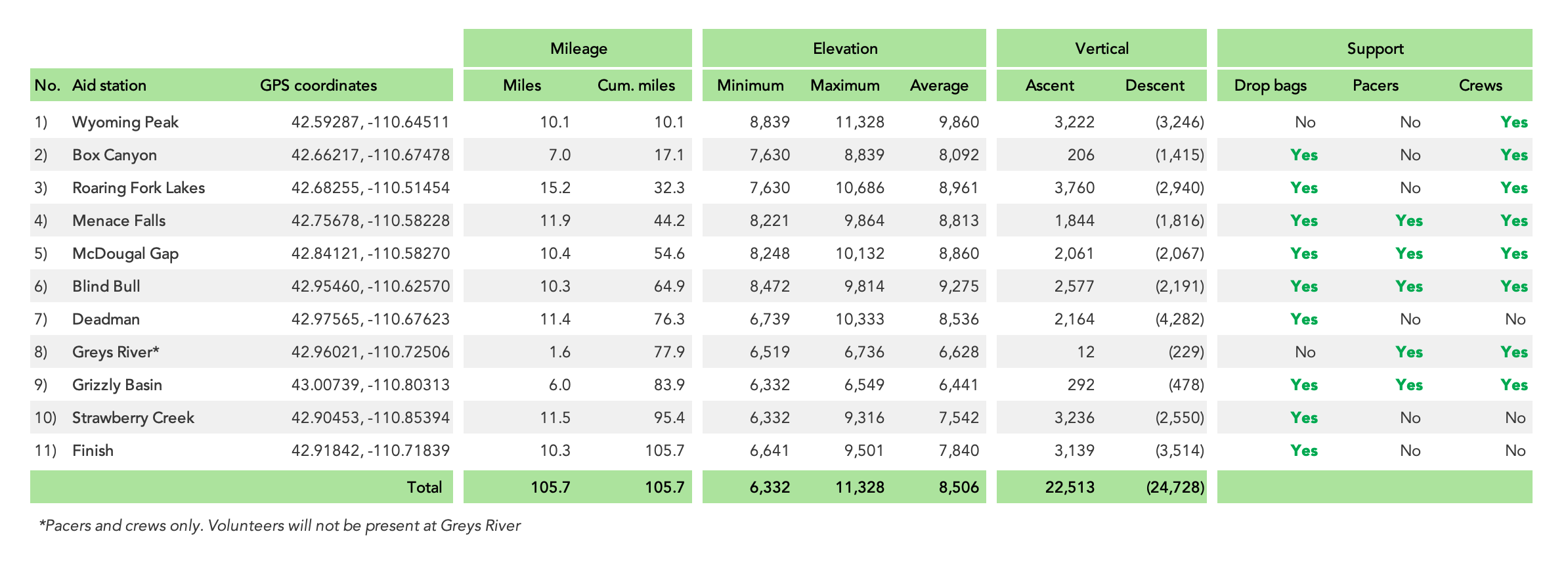
Aid stations
Cutoffs
Although we designed the Wyoming Range 100 to be tough, we did not design it to have a low finishing rate. We want every runner who starts the race to finish the race. To help make this happen, we only have three cutoffs on the course.
| Cutoff (hours) | Aid station | Miles | Time of day |
|---|---|---|---|
| 22 | McDougal Gap | 54.6 | 5:00am Saturday |
| 36 | Grizzly Basin | 83.9 | 7:00pm Saturday |
| 48 | Box Y Ranch (Finish) | 105.7 | 7:00am Sunday |
But do not be fooled by the seemingly generous cutoffs. We’ve had plenty of runners who got behind the first cutoff because they started a bit too conservatively. If you arrive at the finish after the cutoff, you’ll be the proud recipient of an (unofficial) finisher buckle.
Enforcement
We will enforce the McDougal Gap and Grizzly Basin cutoffs on the “exit” side of the aid station. This means you must leave the aid station before the cutoff time.
If, for example, you enter McDougal Gap at 4:58am and sit for five minutes, you will not be allowed to continue. The aid station captain is solely responsible for enforcing the cutoff and will go by their watch and their watch alone, which will be synchronized with the race time.
In the same vein, an aid station captain may pull a runner from the course at any time, if the captain believes it is unsafe for the runner to continue. Keep in mind, we do not want to pull anyone from the course. Again, we want everyone to finish. Our volunteers will do everything in their power to keep you moving – up to and including throwing you out of an aid station.
The finish line cutoff will similarly be enforced against the race time. This means that, if we start the race at 7:03:32am on Friday, the 48-hour cutoff will be 7:03:32am on Sunday. The finish line race clock will be the official device (with the RD’s watch as a backup).
Aid station captains have the final say
Just it case it doesn’t go without saying, while the Wyoming Range 100 only has three “official” cutoffs, we fully empower our aid station captains to pull runners who are not fit to continue. Our captains are seasoned ultra-runners and outdoorspeople. They know the course and the challenges it presents.
If a captain says you cannot continue, there is no negotiation — you are done. Please, respect their decision and come back next year to get the job done.
Weather holds will extend cutoff times
In the event of a weather hold, we will extend cutoffs at “downstream” aid stations. If, for example, we have a 30-minute weather hold after the McDougal Gap cutoff but before the Grizzly Basin and Finish cutoffs, we will extend the cutoffs of the latter two aid stations to 7:30pm Saturday and 7:30am Sunday, respectively.
Dropping
Philosophy
Our dream is a 100% finish rate. We want to make dropping harder than continuing. You can be confident that everyone associated with the race will marshal their total resources and energies to keep you moving.
Process
If you drop, you must do the following things:
Commit to coming back: Look the aid station captain in the eye and say, “There is nothing more I can do. I am dropping. But I will be back.”
Turn over your belt buckle: We make runners carry their belt buckle from the start. If you drop, you must turn it over to the aid station captain.
Turn over your Garmin tracker: Don’t forget to give your Garmin tracker to the aid station captain. This is how we formally memorialize that you have dropped.
Tell the aid station captain how you are leaving the aid station: If, for example, your crew is driving you, you must present a crew member. If you’d like to ride with a volunteer, please be aware you could be waiting for a long time. Volunteers will do their best to make you comfortable in the meantime. It’d likely be easier to catch a ride with another runner’s crew.
Warning
If you drop without following the above process, and we send out a search party, you will be responsible for the full cost – up to and including a formal search and rescue mission supported by helicopters and specialized personnel.
Solo runners
If you are a solo runner and drop, the aid station captain will coordinate a ride for you to the finish – not to the start. We simply ask for your patience, particularly at some of the more “distant” aid stations, like Roaring Fork Lakes and Strawberry Creek.
Drop rate by aid station
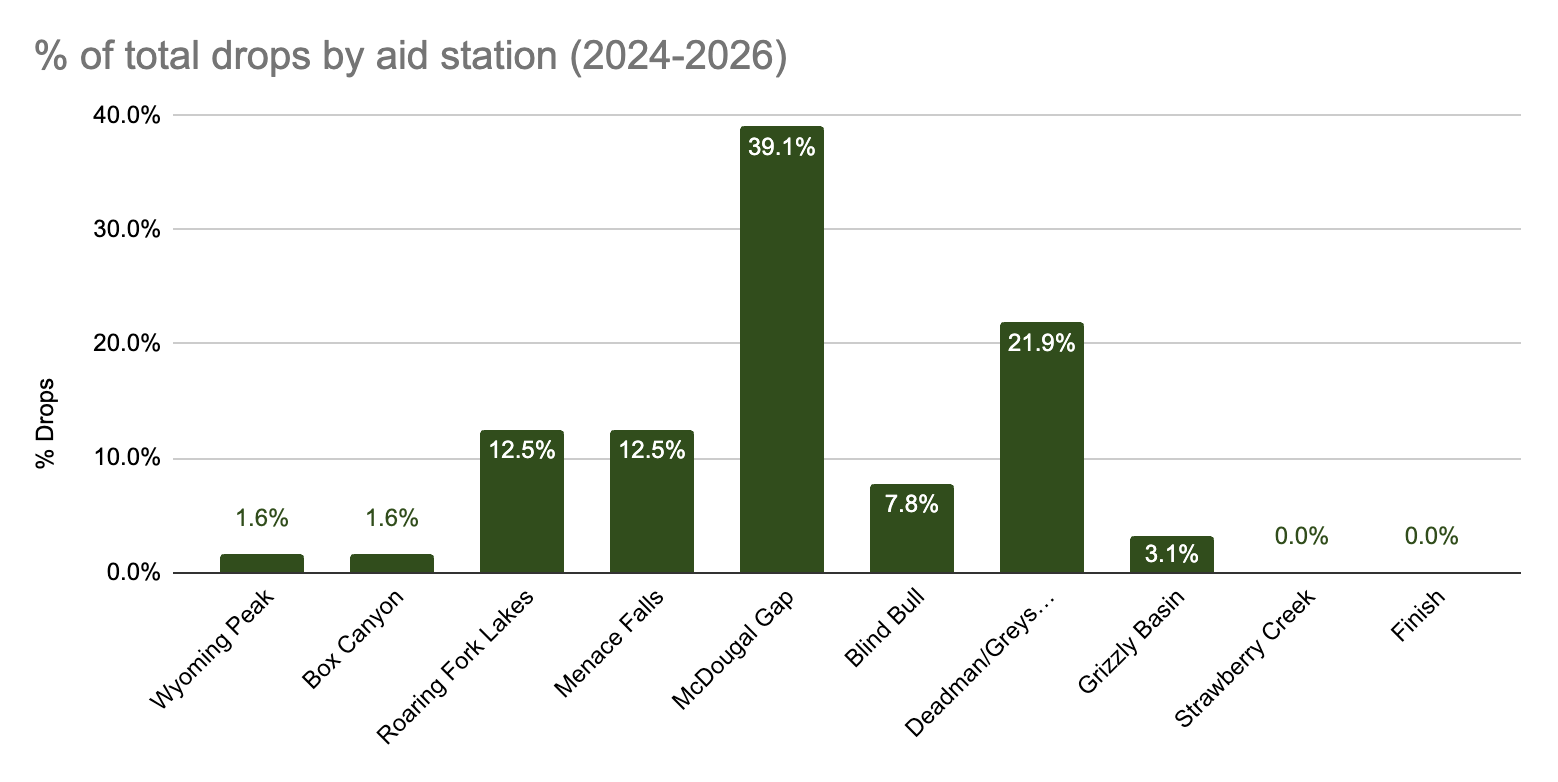
Our average finishing rate on the “modern” course ending at the Box Y is 71.6%. Most of our drops are clustered around the middle of the race — between Roaring Fork Lakes and Deadman.
The following chart shows the percentage of drops by aid station. 7.8% of the runners who have dropped, for example, have done so at Blind Bull. The combined 3.2% of drops that occurred at Wyoming Peak and Box Canyon were all from injury.
Food and drinks
Food
All aid stations will have an assortment of “quick” sweet and salty foods — chips, pickles, cookies, bananas, gummy bears, PB&Js, potatoes, etc. Aside from the first aid station, our aid stations will also have “real” and hot foods, like quesadillas, burgers, soups, and bacon.
If you have significant dietary restrictions, PLEASE pack your own food in your drop bags and/or backpack. While we do our best to accommodate a range of appetites and diets, we simply cannot meet everyone’s needs. Our volunteers are awesome but don’t have the wherewithal to definitively say if a given food has certain ingredients or was prepared in a particular way.
You can view our food/nutrition plan here — an actual look at what will be in each aid station.
Drinks
Every aid station will have potable water and Tailwind. If you’re concerned about a particular Tailwind flavor or whether it has caffeine, please pack your own performance drink. Most aid stations will have soda and coffee, too.