
Winners and DFL
| Year | First Female | First Male | DFL |
|---|---|---|---|
| 2026 | 28:41:48 - Ginny Robbins | 25:38:02 - Cody Poskin | 47:49:13 - Jian Jing, Amy Clauss |
| 2025 | 28:33:47 - Ginny Robbins | 26:42:05 - Cameron French | 55:54:30 - PJ Jungels |
| 2024 | 36:31:04 - Andrea Purtzer | 27:05:29 - Zachary Cohen | 52:24:20 - Mario Gutierrez |
| 2023 | 27:47:37 - Ginny Robbins | 28:16:44 - Jared Campbell | 52:28:34 - Alex Bennett |
| 2022 | 28:19:59 - Ginny Robbins | 26:15:35 - Ross Ring-Jarvi | 59:18:12 - John Langford |
| 2021 | 35:44:18 - Lisa Verwys | 32:35:28 - Michael O'Brien | 48:37:12 - Jack Kurisky |
Results and splits
| Results | Splits | Map | Distance | Elevation | Finish Rate | Avg. Finish | Avg. Pace |
|---|---|---|---|---|---|---|---|
| 2026 | 2026 | 2026 | 105.8 | 24,000 | 63.7% | 40:02:30 | 22:43 |
| 2025 | 2025 | 2025 | 105.8 | 24,000 | 79.7% | 40:32:27 | 22:59 |
| 2024 | 2024 | 2024 | 105.8 | 24,000 | 71.4% | 41:58:29 | 23:48 |
| 2023 | 2023 | 2023 | 102.6 | 20,900 | 55.0% | 38:10:25 | 22:19 |
| 2022 | 2022 | 2022 | 102.6 | 20,900 | 88.9% | 38:08:54 | 22:19 |
| 2021 | 2021 | 2021 | 100.1 | 28,900 | 24.1% | 43:01:46 | 25:48 |
Event records
Women: Ginny Robbins, 27:47:37 (2023)
Ginny Robbins of Victor, Idaho cruised to a 28:19:59 finish in 2022. A year later, she took first overall and beat her own course record in an insane time of 27:47:37.
The weather was amazing from start to finish. While temperatures creeped into the high 70s on Saturday afternoon, Ginny and her fellow runners didn’t have to deal with precipitation. Nighttime temperatures were in the low 30s.
The trail was tacky and overgrown in many places. A relatively wet spring stretched the annual “green up” well into the summer, giving ground-level plants more time to grow up. There were also far more stream crossings than prior years because seasonal springs had not yet dried up.
Men: Cody Poskin, 25:38:02 (2026)
Despite day- and night-time temperatures 20 degrees above average, Cody carved 35 minutes off the men’s course record. He led the field nearly wire to wire and dug himself out of a low spot between Grizzly Basin and Strawberry Creek. Cody hails from Missouri, though rumor has it he’ll soon relocate to the mountain west.
2026 offered runners dry conditions — “There were only 100 water crossings this year!” — with relatively short growth in the meadows. And, despite our volunteers clearing over 400 logs from the course, runners still lumbered over or worked around more than a few downed trees. Smoke moved in and out throughout the weekend.
“Event” record instead of “course” record
We have “event” records instead of “course” records because the former incorporates the small, year-over-year changes that most courses undergo. Courses change — events do not.
Credit to VHTRC for the “event record” concept, which the 2018 Hardrock 100 Runner’s Manual captures nicely. The fact sheet on page 66 shows the difference in course lengths over a three-year period: 100.3 miles (2003), 101.4 miles (2004), and 100.4 miles (2005). With a five-year average finish time of 39:20:17 across all runners, that extra mile in 2004 makes a difference — a 23:21 difference!
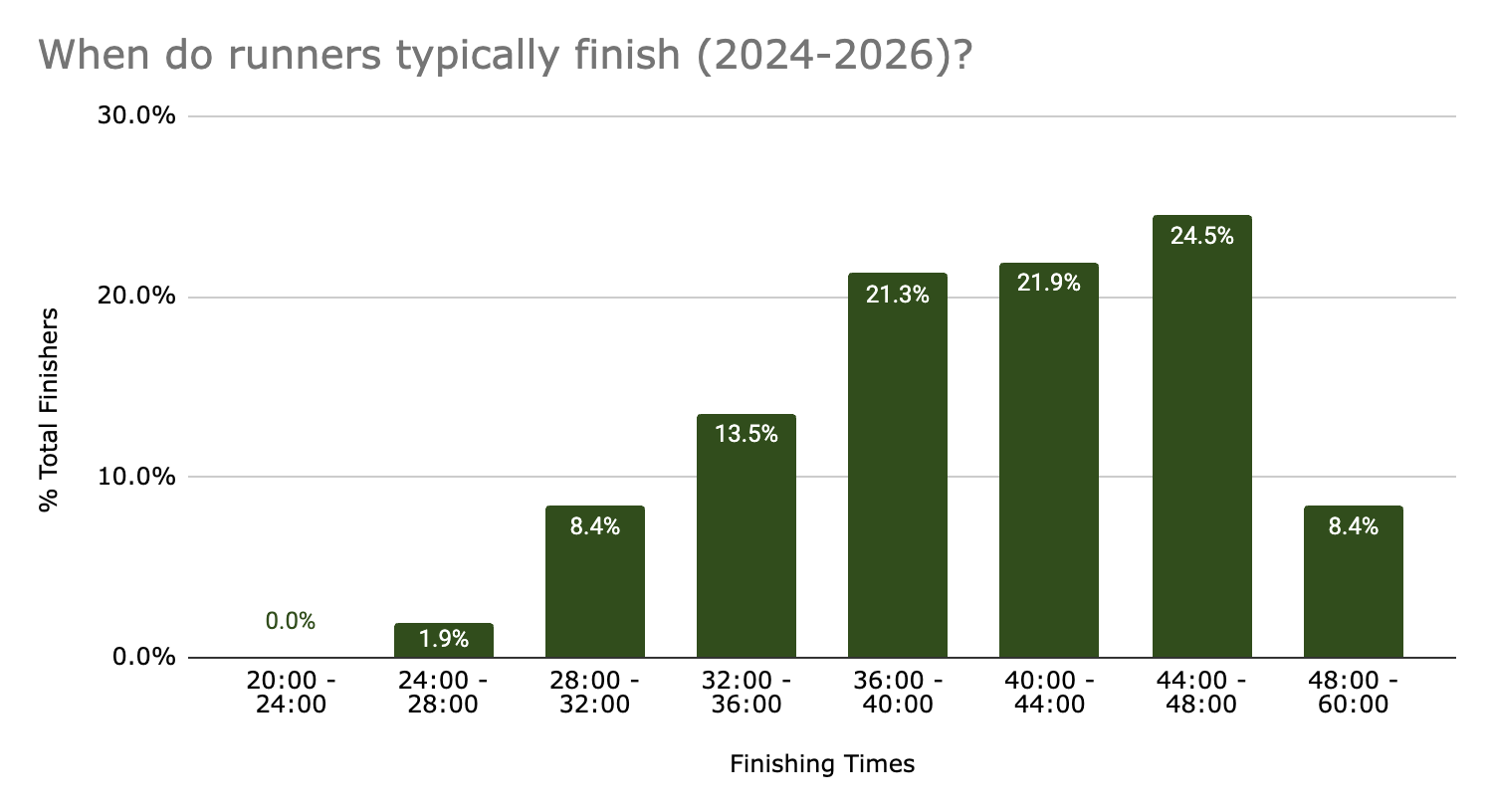
Typical finishing times
It’s the most consistent piece of feedback we get: “This race took far longer than I expected.” Only 24% of runners have finished under 36 hours, while a modest 45% have arrived at the Box Y in under 40 hours. We have (yet) to witness a 24-hour finish…